
Reliance Industries (RIL) has reset its battery pack production timeline, shifting it from 2023 earlier to 2024, details shared in the oil-to-telecom conglomerate's latest annual report suggest. In the FY23 annual report released on Sunday, the company has listed the start of battery pack production in 2024. A year ago, at the company's annual general meeting (AGM), Mukesh Ambani, chairman and managing director of RIL, had said, "We aim to start production of battery packs by 2023 and scale up to a fully integrated 5 GWh annual cell-to-pack manufacturing facility by 2024."

Reliance Industries (RIL's) annual report released on Sunday highlighted the company's focus on new energy solutions, with chairman and managing director (MD) Mukesh Ambani stating that the age of fossil fuels will not continue much longer. RIL has sought shareholders' approval to give Ambani another five-year term as MD till 2029 at nil salary. The recently demerged Jio Financial Services, which "will leverage the prowess of digital and retail businesses", was expected to be listed soon.
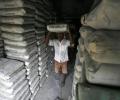
Cement manufacturers' show during the June 2023-ended quarter (Q1FY24) has indicated an intensified slugfest for market share. For instance, Dalmia Bharat (Cement) said it has lost market share in eastern India owing to lack of price discipline. Industry analysts also said that the seasonal weakness in cement prices for Q1 is showing up earlier than usual.
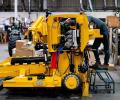
Capital goods companies are likely to report double-digit growth in sales and profit for the first quarter of the 2023-24 financial year (Q1FY24), according to analysts. The performance will ride on lower raw-material costs and healthy execution of orders. Sales by capital goods companies are likely to increase 13-20 per cent year-on-year (YoY), five domestic brokerage firms said.

Billionaire Gautam Adani on Wednesday shared a personal note on the development of Dharavi in Mumbai, days after the Maharashtra government issued a resolution to award the Dharavi redevelopment project to his conglomerate on July 14. In the note shared with the media, Adani said his first tryst with Dharavi in Mumbai was in the late 1970s, and the slum settlement continues to amaze and inspire the billionaire to date. "When this opportunity to renew Dharavi came calling, I seized it with both hands," he said.

It's always been a struggle for economists and statisticians to forecast India's gross domestic product (GDP) correctly, and say where the economy is headed before the official numbers come out. If estimating the GDP is tough, forecasting it in real time is complicated. It involves looking at tens of indicators, such as industrial production, electricity consumption and exports, to arrive at a number.

There's no place like home, but even for the affluent buying one in India is difficult. On top of that, the coronavirus pandemic-now in its eighteenth month-has made life uncertain. A hopeful thing is buying a house looks alluring as loan interest rates fall below 7 per cent, their multi-decadal lows. The slow decline in GDP growth after demonetisation, followed by the economic shock caused by Covid-19 waves, has hurt us unevenly.
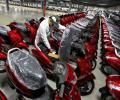
Retail sales of cars are back to January 2018 levels in August 2021. Two-wheeler retail sales are 22 per cent lower, nearly four years down the line.

It emerges that Vi has probably offered good data quality despite being short on spectrum and infrastructure due to its stretched finances. Did the two companies that merged face the heat due to price wars? Probably. Did the government's tough stance in demanding its "due" share of telecom revenues hurt the company? Certainly!
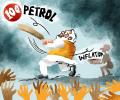
An average Indian spends no more than Rs 1.3 lakh per year, according to official statistics. This is close to what an average Indian earns annually. At this level of per capita income today, one litre of petrol costs one-third of an average Indian's daily income (Delhi prices), making it highly unaffordable. People in most other Asian and emerging countries find it more affordable.

India has placed orders for 786 million doses till date -- less than the probable need of 950 million doses, reports Abhishek Waghmare.

About 150 years ago, in British India, big farmers in the western region of Maharashtra agitated over unfair lending practices and demanded a more fair and inclusive financing structure. People say this is where the seeds of the cooperative movement, now omnipresent in the country, were sown. Today, more than 800,000 cooperative societies thrive in India, with 300 million members, a number close to the population of the United States. Despite a reach this deep--grass roots as they call it--cooperatives do not occupy a lion's share in the Indian economy.

Whenever the Census operation resumes, it will capture the impact of Covid-19 to a large extent, including the extra-lethal second wave, reports Abhishek Waghmare.

The average rate of COVID-19 vaccination in the country has been 10.8 million per week. At that rate, it will take India till December 2024 to complete two billion doses.

This will cost the government Rs 3.1 trillion, about 10 per cent of its annual expenditure, and higher than any other spending item in its Budget.

As India begins vaccinating the younger population, the most vulnerable remain largely unvaccinated.

UP Rs 50 billion, followed by Maharashtra, Bihar, and West Bengal which may need close to Rs 25 billion for the massive task.
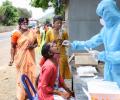
Three of the four major states delayed testing despite worsening indicators. Only Tamil Nadu quickened the pace after the first signs of deterioration.

As the second wave sweeps through the country, restrictions on movement and public activity are not as strict, even though the caseload and death rate is worse than before, reports Abhishek Waghmare.

It has taken 51 days to reach a daily caseload of 84,000 from 11,000, as against 85 days taken in the first wave, report Abhishek Waghmare and Sohini Das.
 © 2026 Rediff.com - Advertise with us - Disclaimer - Privacy Policy - Sitemap - Feedback - About us - Terms of use - Grievances